

It started last spring, and by the time fall semester began it was in full swing – the majority of my conversations with students and colleagues are now about the intersection of AI and sustainability. Students wondered out loud about the environmental impact of USC’s ChatGPT license, which gives us access to the product at no cost to the user. Then there are those of us working in the climate space who (I’ll speak for myself) are wringing our hands. I use AI everyday. It has sped up the process of gathering research remarkably. And yet I know the negative impacts of AI as well, environmental and otherwise.
I was so impressed by a recent thoughtful and nuanced conversation on this topic with the four undergraduate and graduate research assistants with whom I work that I asked if they would share their thoughts publicly. If you’re curious what smart, climate conscious people about to enter the workforce have on their minds when it comes to AI and sustainability, take a read below.
Allison Agsten, Director, Center for Climate Journalism and Communication
You have probably asked an AI something today. A question you were embarrassed not to know the answer to, a task you didn’t have time for, a decision you wanted help making. The result arrived in seconds, clean and confident, from what feels like nowhere. That feeling of frictionless, weightless intelligence appearing on demand is one of the genuinely remarkable things about this moment in history. It is also a carefully constructed illusion. AI has a very real, materialized reality that should concern us all.
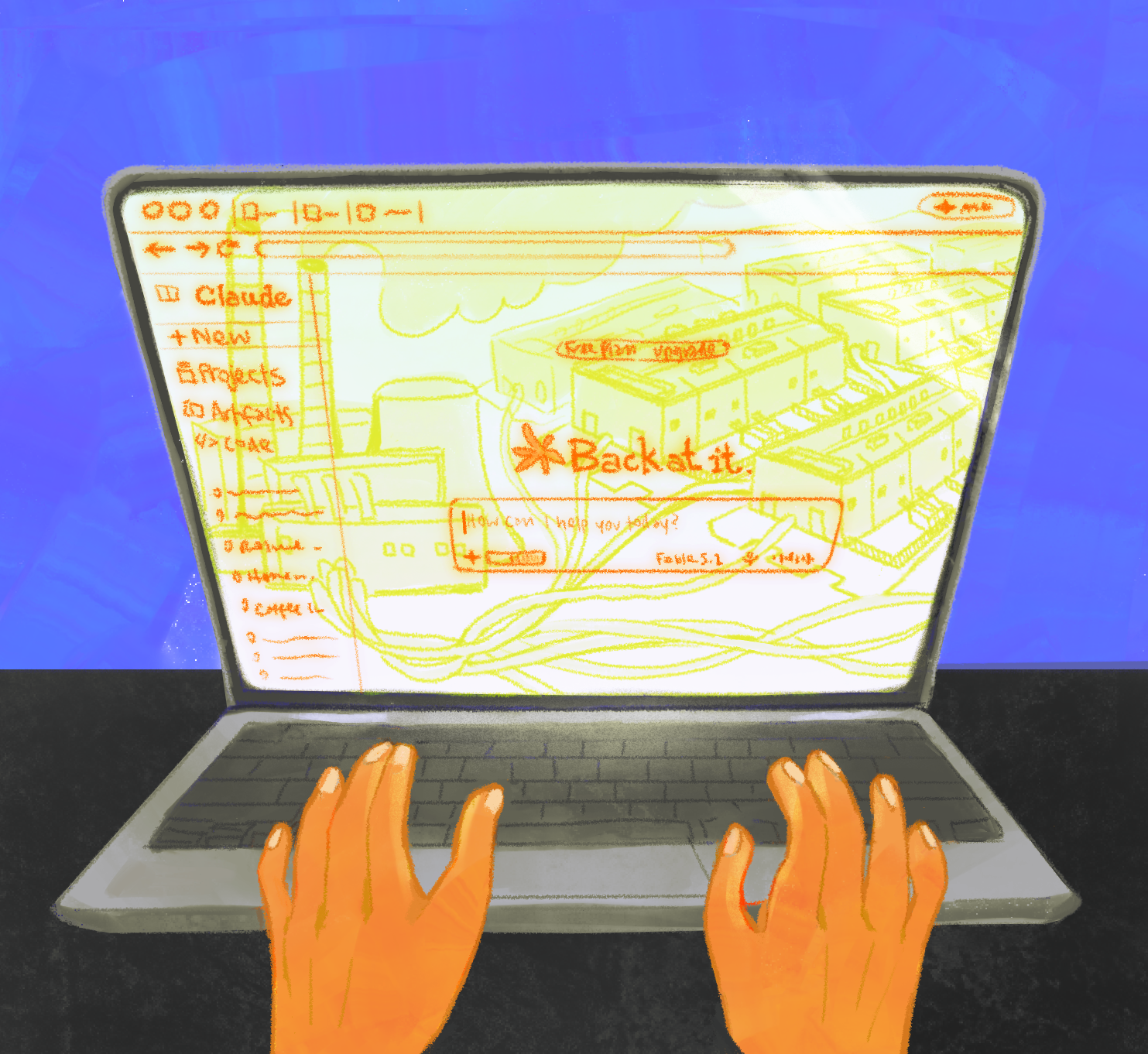
The easiest visual shorthand for AI is the data center; those massive, windowless, humanless buildings appearing in almost every state in America. They’re being built on farmland, on the outskirts of small towns, and in agricultural valleys.
And they are extraordinarily thirsty.
A single hyperscaler data center consumes between one and five million gallons of water per day, mostly used to prevent machines from overheating. For context, the average American household uses about 300 gallons a day. The water data centers use is pulled from local sources, run through cooling systems, and evaporated into the atmosphere. Unlike a household, which draws water and returns it to the sewage system, a computer’s heat evaporates water particles into the air, where it may not return to the earth’s surface for years.
If the infrastructure is this water-hungry, you would think they should be built in wet conditions with plentiful access to water, but unfortunately this is not the truth. Dry air reduces the risk of corrosion in the sensitive servers and electrical equipment, making arid regions more cost-effective to operate in. Low-humidity locations mean lower maintenance costs, plus the land is cheap, permits are easier to obtain, and the people most affected are least positioned to fight back. Roughly two-thirds of data centers built since 2022 have been located in water-stressed regions.
A 2024 report from Lawrence Berkeley National Laboratory for the Department of Energy found that U.S. data centers used about 176 terawatt-hours of electricity in 2023, roughly 4.4% of the country’s total. In 2018, the figure was about 76 terawatt-hours, or 1.9%. The report ties much of that growth to servers built for AI.
As of today, our power grid is antiquated and can not accommodate this sudden spike in energy demand. Instead of bottlenecking through permitting regulations and year-long queues, hyperscalers have opted to produce their own power on-site. This behind-the-meter strategy privatizes this historically public commodity, and due to new incentives from the Trump administration, this electricity is encouraged to be produced from oil, gas, or coal.
At the other end, the UN’s Global E-waste Monitor counted 62 million tonnes of electronic waste worldwide in 2022 and documented only 22.3% of it as formally collected and recycled. Neither figure is specific to AI hardware. They describe the supply chain that AI hardware belongs to.
The hardware necessary for AI to develop is created and disposed of far from the data centers. In 2016, Amnesty International found children as young as seven mining cobalt in the Democratic Republic of the Congo for one to two dollars a day. Amnesty followed that cobalt to battery makers who say Apple, Microsoft, and Samsung are among their customers, and none of the brands it contacted could verify where their cobalt came from. On the other end, the UN’s Global E-waste Monitor counted 62 million tonnes of electronic waste worldwide in 2022 and documented only 22.3% of it as formally collected and recycled. Neither figure is specific to AI hardware; they describe the supply chain that AI belongs to.
Angelina Silvestri, AI x Sustainability
Student Reflections
Angelina Silvestri (MS Integrated Design Business and Technology):
I am someone who cares about the earth, about justice, about the communities being asked to shoulder costs they never agreed to endure. But I am also someone who uses these tools every day, who finds them genuinely useful, and who has not meaningfully changed her behavior in response to what she knows.
A particular kind of passivity comes from being a beneficiary of a system you did not choose and cannot individually dismantle. It can look and feel like pragmatism. But it functions as permission; permission for the system to keep running, permission for the costs to keep landing somewhere else, permission for the guilt to stay at a volume low enough to live with.
The decision to let our planet bear the responsibility of AI expansion was made with the same mix of regulatory capture and manufactured urgency that makes objections feel futile. In terms of its impact on our species, the burden of AI is not shared equally. The question of whose discomfort is a problem worth solving, and whose is simply the cost of progress, has gone unanswered by the leading figures in AI.
We have all made a version of this arrangement with ourselves: the belief that our personal commitments to doing less harm can coexist with our enthusiastic participation in a system where harm is someone else’s reality. The industry is designed to maintain exactly this gap because a consumer who feels slightly guilty but keeps consuming is still the profitable kind.
James Landis (Senior, Economics Major, AI Minor):
Prompt: How much of this is ours to carry, and how much belongs to the companies and policies behind the machine?
The prompt above frames the tension around AI’s environmental impact very well; AI is a technology handed to us, but the power to regulate it belongs to companies and policymakers. Regulating AI isn’t solely our burden, but I think people should understand how AI queries get a response.
When you send a message:
- Your message travels over the internet to a data center (DC)
- The message is split into tokens
- Computer chips run tokens through a model to predict the most likely next token
- This repeats for every token; a response is sent back to you
Data centers use a lot of electricity to power the above process. Understanding the bigger picture helps people see the impacts of DC energy demand: grid strain, higher bills, and more fossil fuel use. On the flip side, they can learn about AI’s potential to solve problems, from improving storm forecasts to detecting wildfires to discovering new antibiotics to fight infection. Additionally, panelists at the USC Energy Business Summit 2026 explained how DCs bring greater tax revenue and jobs to local areas, leading to better roads, facilities, and a stronger local economy. People should know the pros and cons, so they can weigh the trade-offs for themselves and society. And, for those who feel change is necessary, they’ll understand what’s at stake and can hold companies accountable and push for better policy.
One final thought:
I’ve noticed AI increase efficiency and productivity for many careers and activities, from learning new subjects to gathering basic research to summarizing complex documents. I want to make it clear, though, that there’s a difference between using AI as a tool versus having it do your work. In my experience, when I rely on AI, I
1) retain less about the topic
2) produce writing that sounds less like me, and
3) don’t build critical thinking, a key goal of school assignments.
As AI gets introduced to campuses around the world, I feel universities should play a role in helping students navigate the line between reliance and assistance.
Gina Lee (Senior in PR & Advertising, minoring in Customer Analytics):
In my economics class, we learn about the K-shaped economy: the theory that societal growth is split into two classes that, over time, diverge further from one another. The upward arm of the “K” represents high-earning households and sectors that continue to benefit from waves of stock appreciation and technological growth; while the downward arm represents lower-wage workers and industries that missed the trend, facing lower income gains and labor disruption.
It’s easy to see how unequal AI adoption maps onto a similar pattern. Who has access to the technology and knows how best to use it has direct implications for who gets ahead in the race. And while it may be too early to see journals and research studies on the fact, we, as students, see hints everywhere: job listings increasingly asking for AI literacy, professors who hem and haw on AI usage in assignments, and classmates who do more because they can relegate “busy work” to Chat.
There has undoubtedly been incredible A.I. innovation across industries like healthcare, and even spaces where A.I. is aiding resource efficiency and other sustainability efforts. But as a student and creative, I am deeply worried about the environmental and ethical effects of generative A.I. — as many students likely are too. It can feel difficult and uncomfortable to reconcile what my gut says versus what the world is doing. Choosing not to use A.I. in my learning or personal life feels like swimming down against upstream currents.
As an individual, it sometimes feels as though I can only wait for a large, societal shift to save the planet. It took half a century for scientists to discover that cigarettes were carcinogenic and smoking was bad for you, decades more for government regulations to fall into place, and now cultural norms are still slowly counterbalancing globally. I hold onto the hope that, surely, our frustrations will eventually reach the ears of policymakers, researchers, and decision-makers who recognise that A.I. is under-regulated.
I’m reminded of movies that I grew up with, like WALL-E: where the underdogs defeat the A.I. autopilot onboard the Axiom ship, plot a new course for humanity, and return life to Earth. In all of these stories, all it takes is one revelation and the protagonists’ relentless optimism to bring society back from the brink of collapse and restore nature. If the damage is reversible, then someone can always trigger a paradigm shift — like making data centers sustainable, or leading a breakthrough in the clean energy transition.
WALL-E also shows us that agency can be wrought back. Maybe if we are to leave some everyday comforts of technological reliance and passivity, we could also help steer a different path for our Axiom.
Ellen Davis (Senior, Healthcare Policy Major, Hayes Barnard Sustainability Fellow):
I know the dangers AI poses to the environment and my cognitive function, yet I use it anyway because society rewards efficiency and performance, not quality and authenticity.
Despite my best efforts to relinquish my desire for external validation, I – like many other students and pre-professionals – struggle to shift my attention from performance measures and outcomes to actual learning and growth. While grades, job titles, etc., create a standardized system necessary for determining a person’s competence, the increased emphasis on these metrics shifts attention away from the qualities that they are intended to represent. We are increasingly evaluated based not on our passion, commitment, and quality of work, but rather the labels we can extract from our experiences. This truth applies not just to academia and the professional world, but also to individuals’ personal lives, as young people increasingly feel the need to be “productive” in their hobbies.
AI enables this endeavor for continuous productivity and accomplishment. There is no doubt that by alleviating certain administrative burdens, AI has increased people’s efficiency and capacity for additional tasks and, consequently, production. As a senior and soon-to-be graduate, I feel intense pressure to keep up with these trends, even though I understand that true value lies not in the outcome but in the process. Although my resistance to using AI holds strong under most circumstances, certain sub-optimal conditions ignite a desperation that is difficult to control. When I am not constantly celebrating a new achievement, the fear of falling behind and becoming obsolete –as a student, employee, and well-rounded, interesting person– becomes all-consuming. Suddenly, then, compromising my integrity and commitment to sustainability seems like a small price to pay. In these moments, learning becomes secondary to what feels like a dire, frantic need to produce the expected outcome so that professors, employers, and peers may see my value.
Ultimately, I see AI as a tool made valuable by a culture defined by the prioritization of convenience and rapid production. Although it has the potential to be used for good, for example, to streamline the massive administrative burden that plagues the US healthcare system, it is difficult for me to trust that the technology is anything more than an accelerant in humanity’s journey to the complete exploitation of both the Earth and ourselves. It is unfortunate that this perception is so far removed from my present reality… perhaps it would outweigh my fear of falling behind in school.